Elk Grove Village
Elk Grove Village, IL
Invisalign Dentists near me
Dental.me organizes 31,665 indexable invisalign dentists profile matches, including 27,411 enriched or source-supported profiles. Pick your state and city to jump straight into ranked invisalign dentists near you.
At a glance
The complete guide
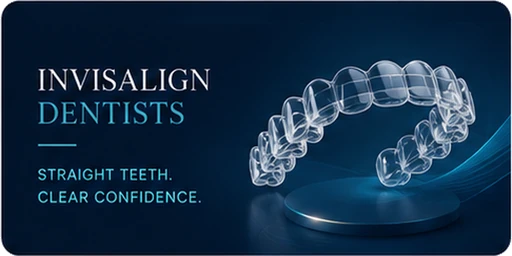
Invisalign is a brand of clear aligner therapy that straightens teeth using a series of custom-made, removable plastic trays instead of metal brackets and wires. Each tray in the series shifts your teeth a small amount, and you move to the next tray every one to two weeks until your teeth reach their final position. Clear aligners are nearly invisible, can be taken out to eat and brush, and are a popular alternative to traditional braces for people with mild to moderate alignment issues.
Clear aligners work by applying gentle, controlled pressure to specific teeth, nudging them into a new position a fraction of a millimeter at a time. An Invisalign dentist uses a digital scan of your mouth to map out every stage of movement before you start, so the entire treatment is planned from day one.
That digital plan generates a series of trays — sometimes a few dozen, sometimes 20-30 or more depending on the case — each one slightly different from the last. As you progress through the series, teeth are guided step by step toward the planned final alignment. Because each tray is custom-fit to a specific stage, the aligners feel snug when first worn and looser as your teeth catch up to that tray's shape, which is a normal sign that movement is happening.
Clear aligners work well for many common alignment problems, but they aren't the right tool for every case. A consultation with an Invisalign dentist or orthodontist is the only way to know if your case is a good fit.
Clear aligners are generally effective for:
Clear aligners tend to be less effective, or need to be combined with other tools, for:
Clear aligners are removable, nearly invisible, and generally more comfortable day to day, while traditional braces are fixed to the teeth and often better suited to complex or severe cases. Neither option is universally "better" — the right choice depends on your bite, your lifestyle, and your treatment goals.
Because clear aligners are removable, success depends heavily on wearing them as directed — a discipline traditional braces don't require.
Clear aligner treatment starts with a digital scan or impression of your teeth, followed by a custom treatment plan, and then a series of trays you wear in sequence with periodic check-ins. Most patients are surprised by how straightforward the day-to-day routine becomes once they settle into it.
Your Invisalign dentist examines your teeth and bite, then uses a 3D digital scanner (or in some cases traditional molds) to capture the exact shape of your mouth. This scan becomes the foundation for your entire treatment plan.
Software maps out the projected movement of each tooth from start to finish, and your dentist reviews and adjusts this plan. You'll often get a preview of your projected final result before treatment even begins.
You wear each set of trays for about 20 to 22 hours a day, removing them only to eat, drink anything besides water, and brush and floss. Consistent wear time is the single biggest factor in whether treatment finishes on schedule.
Your dentist checks progress every six to eight weeks or so, confirming that your teeth are tracking with the plan and making adjustments if needed.
Near the end of treatment, many patients need a round of "refinement" trays to fine-tune the final result before moving into a retainer.
Most clear aligner treatment takes roughly six months to two years, depending on how much movement is needed and how consistently the trays are worn. Mild cosmetic cases can sometimes finish faster, while more involved bite corrections take longer.
Wearing your aligners less than the recommended hours is one of the most common reasons treatment runs longer than originally planned, so consistency matters as much as the treatment plan itself.
Attachments and IPR are two tools an Invisalign dentist may use to help the trays grip teeth better or create the small amount of space needed for movement. Not every case requires them, but they're common enough that it helps to understand what they are.
Attachments are small, tooth-colored bumps of dental bonding material placed on certain teeth. They give the plastic tray something to "grab onto" for more precise movements, especially rotations or vertical shifts. They're removed once treatment is complete.
IPR is the careful removal of a very small amount of enamel between two teeth — often less than the thickness of a sheet of paper — to create room for alignment without extracting a tooth. It's painless and doesn't damage healthy tooth structure when done correctly.
Yes — nearly everyone who completes clear aligner treatment needs to wear a retainer afterward to keep teeth from shifting back. Teeth have a natural tendency to drift toward their original position, especially in the months right after active treatment ends.
Retainers are typically worn full-time for a period after treatment, then nightly on an ongoing basis, though the exact schedule your dentist recommends can vary. Skipping retainer wear is one of the most common reasons a straightened smile relapses over time.
Clear aligner treatment cost varies by case, location, and insurance, but many patients find the price range comparable to traditional braces, sometimes running from the low thousands to several thousand dollars depending on complexity. Mild cases needing fewer trays typically cost less than complex cases requiring attachments, IPR, and refinements.
Many dental insurance plans that cover orthodontic treatment will apply that same benefit toward clear aligners, though coverage amounts and lifetime maximums vary widely by plan. Some practices also offer in-house payment plans or financing to spread out the cost. Always ask your Invisalign dentist for a written estimate that reflects your specific treatment plan before committing.
Clear aligners should be cleaned daily and kept out of contact with anything except water while worn. Good hygiene habits protect both the trays and your teeth underneath them.
Look for a provider with specific clear aligner experience, a track record of cases similar to yours, and a clear, written treatment plan before you commit. Not every general dentist who offers clear aligners has the same depth of experience, so it's worth asking questions upfront.
A provider who takes time to answer these clearly, and who sets realistic expectations rather than promising an unusually fast or guaranteed result, is generally a good sign.
Reviewed by the Dental.me Editorial Team. This article is for general information and is not a substitute for professional dental advice, diagnosis, or treatment. Always consult a licensed dentist about your specific situation.
Start local
City pages with enough matching profiles and source-supported signals to compare invisalign dentists locally. Each opens a ranked city directory.
Browse by state
State hubs connect to city pages, ranked practice profiles, and related specialty paths.
Explore Dental.me
Every specialty is ranked the same independent way. Jump to another care category and search near you.
 Cosmetic DentistryVeneers, whitening, bonding & more.
 Dental ImplantsPermanent replacements for missing teeth.
 Emergency DentistsSame-day care for urgent problems.
 Pediatric DentistryGentle dental care for children.
 OrthodontistsBraces and bite correction.
 Oral SurgeonsExtractions, implants & jaw surgery.
 Root CanalsSave infected or damaged teeth.
 PeriodonticsGum-health and gum-disease care.
 ProsthodonticsRestore and rebuild your smile.
 DenturesFull, partial & implant-supported.
 Teeth WhiteningProfessional brightening that lasts.
Directory methodology
Organic rankings are independent and can’t be bought. Rankings use the Dental.me Score and supported comparison signals including rating strength, review-count strength, profile completeness, verification signals, and freshness. Paid Featured placements are labeled separately and never change the organic order. Category associations come from source-supported provider taxonomy, business categories, website evidence, owner updates, and reviewed workflows. Learn more: How rankings work · Dental.me Score · Verification methodology.
Questions answered
Start with this national hub, choose a city or state specialty page, then compare Dental.me profiles by score, rating, review count, contact details, website, map, hours, categories, and nearby alternatives.
Dental.me uses source-supported provider taxonomy, business category, website, owner-submitted, VA-reviewed, and Google/Maps category signals where those signals are available.
No. Specialty paths organize comparison data. Patients should contact the office directly for treatment-specific questions, appointment availability, insurance participation, and payment details.
Organic rankings use Dental.me Score and supported comparison signals including rating strength, review-count strength, profile completeness, verification signals, and freshness. Featured placements are labeled separately.
Compare Dental.me Score, star rating, review count, website availability, phone number, map link, published hours, provider names, categories, nearby alternatives, and the local city-specialty page connected to each profile.
This hub helps route searches such as Invisalign dentist near me, best Invisalign dentist near me, Invisalign dentist reviews, Invisalign dentist ratings, and Invisalign Dentists by city into Dental.me city-specialty and practice profile pages.
Yes. Practice teams can claim a profile or suggest a correction so Dental.me can review profile details and strengthen the public information.